

Ask any teer follower in the Northeast about the assam teer result and within a minute the conversation turns to Shillong teer. The two games are constantly mentioned together, compared, and sometimes confused with each other. That is understandable: they share the same archery lottery format, the same two round structure, and the same cultural roots. But they are separate games played at separate grounds, producing separate numbers on separate schedules.
This guide untangles the relationship properly. You will learn where the two games come from and what they share, why their results are completely independent, how the Khanapara ground in Guwahati differs from the Shillong grounds, how their daily timings compare, and how to follow both results without ever mixing them up. By the end, you will read any assam teer result with full confidence about which game it belongs to and why.

Assam Teer and Shillong Teer Share the Same Roots
Before the differences, the common ground. Assam teer and Shillong teer are branches of the same tree, and knowing the shared history explains why they look so similar.
One tradition, two markets
Teer began as a pastime built around archery, a skill with deep cultural importance for the Khasi people of Meghalaya and the wider region. Over time, what started as friendly shooting contests evolved into an organised game: archers shoot, arrows are counted, and the last two digits of the count decide a winning number. As the game grew, it spread beyond its original grounds. The Khanapara ground in Guwahati became the home of the Assam market, while Shillong kept its own historic grounds. The format travelled intact, which is why a follower moving from one market to the other finds the same FR and SR structure waiting.
The same FR and SR skeleton
Both games run on the identical skeleton: a first round and a second round each game day, each round producing one two digit number from 00 to 99. In both markets, tickets are sold through licensed counters before each round, the archers shoot a coordinated volley, officials count the hitting arrows, and the last two digits of the count become the result. If you understand how one market works, you understand the mechanics of the other. The archery article on Wikipedia gives useful background on the sport at the heart of both games.
The same legal umbrella
Both games operate as legal lotteries within the recognised teer framework of the region, run through licensed counters with open declarations at the grounds. This shared legal standing is part of why both markets have survived and stayed organised for decades. Participation in either game is strictly for adults aged 18 and above, and the responsible play principles apply equally to both: fixed small budgets, no chasing losses, and treating the game as entertainment.
Separate Draws Mean Separate Numbers
Here is the single most important fact in this entire comparison: the assam teer result and the Shillong teer result are completely independent draws. Sharing a format does not mean sharing numbers.
Why the numbers can never match by design
Each market holds its own shooting sessions with its own archers at its own ground. The arrows counted at Khanapara have nothing to do with the arrows counted in Shillong. Because the winning number comes from the last two digits of a live arrow count, and because the two counts happen in different places with different people, the two results are independent random outcomes. They may occasionally coincide by pure chance, exactly as two dice may occasionally show the same face, but one never influences the other.
The independence habit
This independence has a practical consequence for how you follow the games. Never use one market’s result to interpret the other’s. The Shillong FR number tells you nothing about what the Assam FR number will be, and yesterday’s Assam numbers tell you nothing about today’s Shillong numbers. Treat each market, each date and each session as its own self contained event. Followers who internalise this habit stop making the most common cross market error: assuming a pattern in one game carries over to the other.
Separate archives for separate games
Because the draws are separate, their records must stay separate too. On All Teer, the Khanapara teer result page keeps the Assam market’s numbers, while Shillong’s numbers live on their own market pages, and the teer result list organises everything by date and market. When you look up an old number, always check the market label first. An archive is only useful when every entry is correctly attributed to the game that produced it.

The Grounds Compared – Khanapara vs Shillong
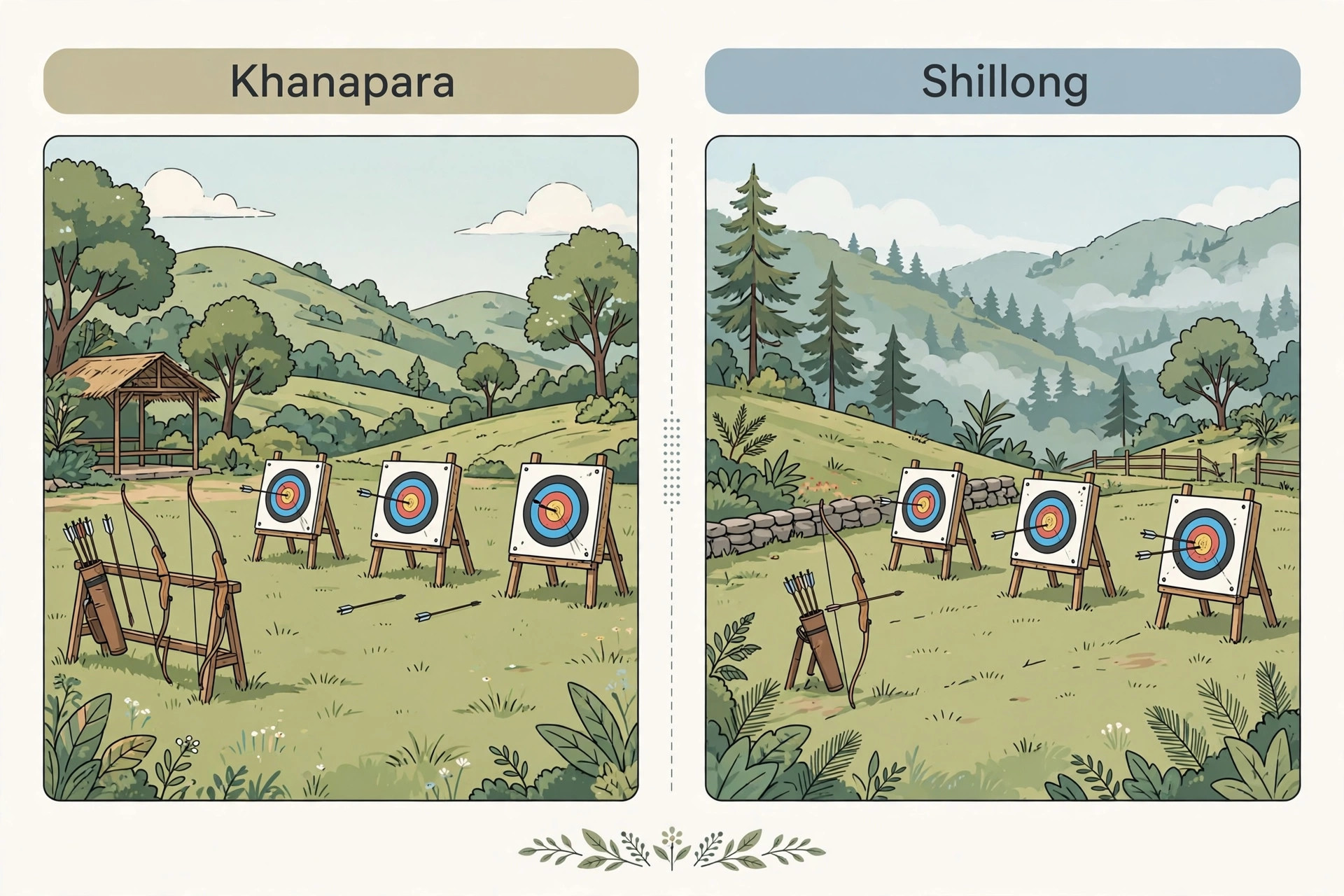
The clearest physical difference between the two games is where they happen. The ground shapes the character of each market.
Khanapara – the Assam ground in Guwahati
The Assam teer game is played at the Khanapara ground on the southern edge of Guwahati, near the Assam Meghalaya border. Guwahati is the largest city of Assam and the commercial gateway of the Northeast, and the Khanapara locality sits along the road toward Shillong, making it accessible to archers, counter operators and followers from both states. The ground is an open field arranged for archery with marked shooting lines and targets, surrounded by the daily machinery of the market: licensed counters across the city selling tickets, officials managing the rounds, and a crowd of regulars who know the rhythm by heart.
Shillong – the original hill grounds
Shillong, the capital of Meghalaya, hosts its own teer grounds with a longer documented history in the game. The most famous is the Polo Ground area, where teer has been played for generations and where the traditions of the game are at their most visible. The hill setting, the local archery clubs and the deep community involvement give the Shillong game a distinct atmosphere that regulars describe with pride. While the format matches Khanapara exactly, the venue, the people and the local customs around the game are its own.
What the ground changes and what it does not
The ground changes the experience but not the mathematics. Different venues mean different archers, different crowds and slightly different daily schedules, but the conversion of arrows to a two digit number works identically in both places. This is why experienced followers speak of the two markets as cousins: same blood, different households. When you read an assam teer result, you are reading the record of what happened at Khanapara that day, nothing more and nothing less.
Assam Teer Result Timings Compared with Shillong
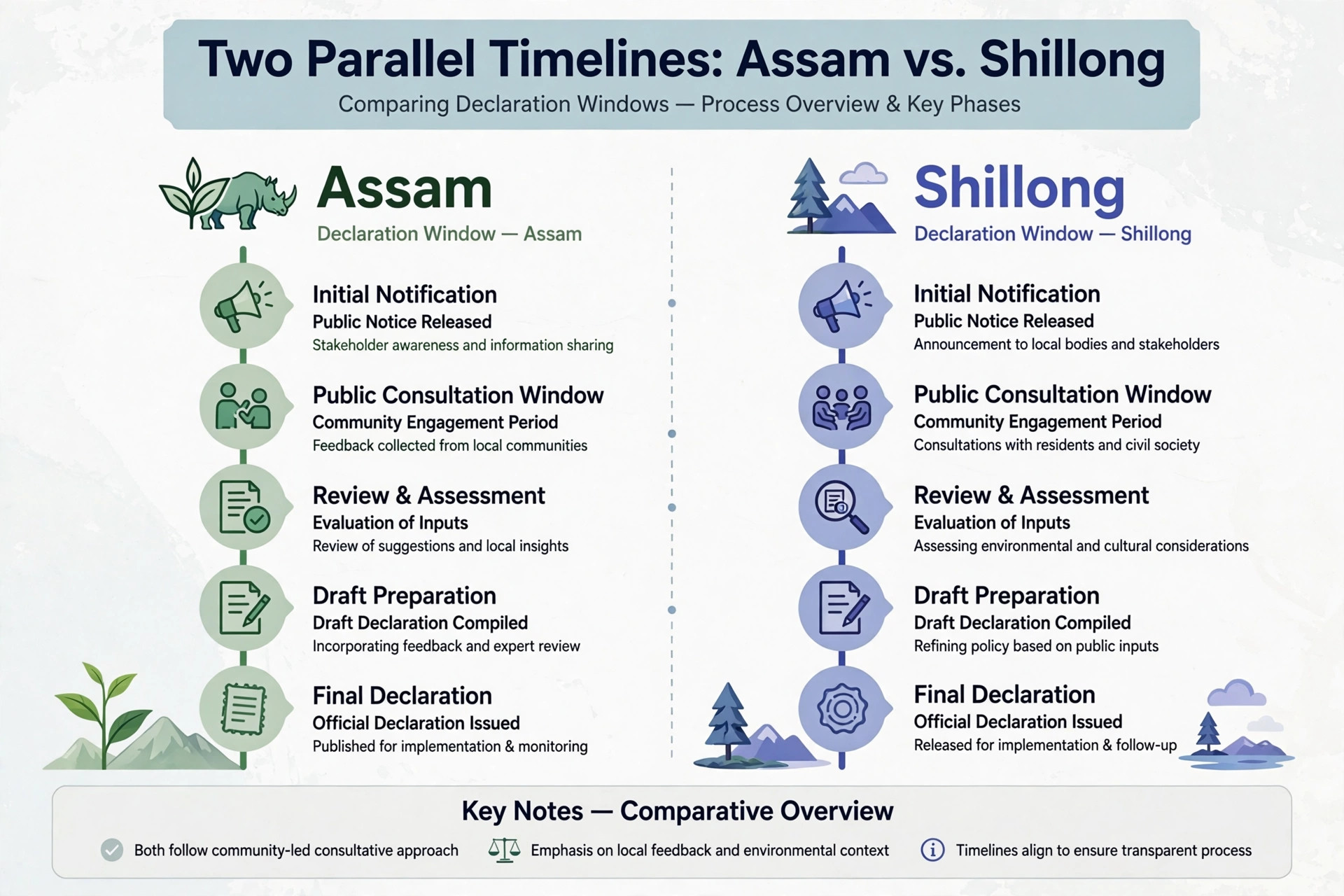
Both markets declare two results a day, but they do so on their own schedules. Knowing both rhythms matters if you follow the two games together.
The Assam (Khanapara) daily rhythm
At Khanapara, the main day game follows the familiar pattern: ticket sales through the morning and early afternoon, the first round shot and counted with the FR result declared in the afternoon, then second round sales, shooting and counting with the SR result declared in the evening. Khanapara also runs a morning session with its own FR and SR declared earlier in the day, tracked separately on the Khanapara morning teer result page.
The Shillong daily rhythm
Shillong follows the same structural pattern of two rounds but on its own timetable, with its FR and SR declarations falling in their own afternoon and evening windows. The exact minutes differ from Khanapara because they depend on local conditions: when sales close, how large the archer field is, and how the counting progresses at that ground on that day. The principle is identical; only the clock positions shift.
Following two schedules without confusion
If you track both markets, keep two separate notes or two separate bookmarks rather than one blended list. Check each market at its own usual time, confirm the market name on the page before reading, and never assume that because one market has declared, the other must have too. Delays at one ground do not affect the other. The official Meghalaya government portal is the authoritative source for the legal framework both markets operate under.
Reading an Assam Teer Result Next to a Shillong Teer Result
The real test of understanding comes when both markets’ numbers sit in front of you at once. Here is how to read them together without mixing them up.
Label everything with market, date and session
Every number you note down should carry three labels: which market it belongs to, which date, and which session. So instead of writing a bare pair of digits, write it as a full record: market, date, session, number. This takes five extra seconds and eliminates the entire category of cross market confusion. When both games are in play on the same day, you will have four numbers by evening: Assam FR, Assam SR, Shillong FR and Shillong SR. Four numbers, four labels, zero ambiguity.
The placeholder format in comparison guides
Comparison guides sometimes show the layout of two result cards side by side using dashes as placeholders, like this: Assam FR: – and SR: – next to Shillong FR: – and SR: – (example only, not a real result). The dashes show the format and carry no meaning. On a real result page, always verify that each card shows the correct market name above its numbers before reading further.
Why side by side reading tempts false patterns
Human minds love patterns, and two pairs of numbers side by side invite the imagination to find connections that do not exist. A follower might notice that the Assam and Shillong numbers ended with the same digit and conclude the markets are linked. They are not. With one hundred possible outcomes per draw, coincidences are mathematically routine. Enjoying the coincidence is harmless; building decisions on it is not. The healthiest way to read both results is as two separate stories that happen to be printed on the same day.
Tickets, Counters and the Local Character of Each Market
The differences between the markets extend beyond the ground into how the game is bought and experienced locally.
Counter networks
Each market is served by its own network of licensed counters. Around Guwahati, counters serve the Khanapara game, while in and around Shillong, counters serve the Shillong game. A counter sells tickets only for its own market’s rounds, so a ticket bought in Guwahati is a ticket for the Assam game and cannot be compared against Shillong numbers. This is worth stating plainly because newcomers sometimes buy at one counter and check the wrong market’s result. Match your ticket to its market: the counter’s location tells you which game you are in.
Ticket prices and prize structures
Both markets use the same basic ticket model: choose a two digit number from 00 to 99, pay the fixed price, and receive a slip. The standard price points and prize conventions are similar across markets because they evolved together, but the prize pool of each round depends on that round’s own sales. A heavily played round builds a larger pool than a quiet one, and this varies independently between Khanapara and Shillong. None of this affects how you read the result, but it explains why followers speak of each market having its own mood on a given day.
The follower communities
Each market has nurtured its own community of followers with its own habits, favourite counters and gathering spots. In Guwahati, the conversation centres on Khanapara timings and the Guwahati counter network; in Shillong, it centres on the hill grounds and their traditions. Online, the two communities overlap constantly, which is exactly why clear market labelling on result websites matters so much. A number without a market label is a number without a home.
Which Game Should You Follow
Newcomers often ask which market is better to follow. The honest answer is that neither is better; they are the same game in different places, and the right choice depends on you.
Follow the market near you
The most practical rule is proximity. If you live in or near Guwahati, the Assam (Khanapara) game is your natural market: its counters are the ones you can visit, its timings fit your day, and its community is the one around you. If you are in Shillong or elsewhere in Meghalaya, the Shillong game plays the same role. Following the nearby market keeps everything simple: tickets, result checks and conversations all line up.
Follow both if you enjoy the comparison
Many experienced followers track both markets purely for the enjoyment of it, treating the two result pairs as a richer daily ritual. There is nothing wrong with this as long as the records stay separated and the budget, if you play, stays fixed. Following both doubles the numbers you read but should never double the money you spend. Set one entertainment budget for the day regardless of how many markets you watch.
What not to base the choice on
Do not choose a market because someone claims its numbers are easier to predict. No market’s numbers are predictable, because every result comes from a live arrow count whose last two digits no one can control. Claims of an easier market are marketing, not mathematics. Choose by proximity and enjoyment, and you will never be misled.
Checking Both Results Without Mixing Them Up
A short practical system for followers who track the two games together.
Two bookmarks, two moments
Bookmark the Khanapara market page and the Shillong market page separately, and check each at its own usual declaration time. The homepage of All Teer gives you the day’s overview across markets, which is a good starting point before diving into each market’s detail. Resist the urge to rely on a single blended screenshot from a messaging group; those are where market labels go missing.
The evening reconciliation
In the evening, once both markets have declared both rounds, do a single reconciliation pass: open each market page, confirm the date, and note the four labelled numbers. This takes two minutes and gives you a clean, trustworthy record of the day. Anything less organised, such as numbers remembered from conversation without labels, should be treated as unreliable until verified.
Teaching the system to others
If friends or family follow the games too, pass on the labelling habit. Most teer confusion in communities comes not from the game but from poorly shared information: a number forwarded without its market, date or session. A community where everyone labels their numbers is a community where nobody argues about which result was which.

Assam Teer Result FAQs
What is the difference between the assam teer result and the Shillong teer result?
The assam teer result comes from the archery game at the Khanapara ground in Guwahati, while the Shillong teer result comes from the teer grounds in Shillong, Meghalaya. They share the same format of two daily rounds producing two digit numbers, but they are separate draws with separate archers, separate ticket sales and separate declaration times. Neither result influences the other.
Are Assam teer and Shillong teer played at the same time?
Both markets follow a similar daily structure with afternoon and evening declarations, but each runs on its own schedule set by conditions at its own ground. Check each market at its own usual time rather than assuming one has declared because the other has.
Can the Assam and Shillong results ever be the same number?
Yes, by pure coincidence, since each draw has one hundred possible outcomes from 00 to 99. An occasional match means nothing and indicates no link between the markets. Each draw is independent.
Which result should I check if I bought a ticket in Guwahati?
Check the assam teer result, which is the Khanapara market game. Counters in the Guwahati area sell tickets for the Khanapara rounds, so your ticket belongs to that market. Use the Khanapara teer result page and match the session (FR or SR) printed on your slip.
Is one market easier to predict than the other?
No. Both results come from live archery counts whose last two digits cannot be controlled or foreseen. Anyone claiming one market is easier to predict is not describing how the game works. Follow the market near you and enjoy the game without expecting patterns.
Do both games run on the same days?
Both markets generally rest on Sundays and may pause on major public holidays, but each market’s schedule is its own. A cancellation at one ground does not affect the other. If a result is missing for one market on a given day, check whether that market held its rounds rather than assuming a website error.
Where can I see both results side by side?
Use a result site that labels each market clearly, such as the market pages on All Teer. Open the Khanapara page for the Assam numbers and the Shillong market page for the Shillong numbers, confirm the date on each, and keep the four numbers labelled by market and session in your notes.
Conclusion
The assam teer result and the Shillong teer result are two chapters of the same story: one archery lottery tradition, expressed in two proud markets at Khanapara and Shillong. They share the format, the two round structure and the legal framework, but their draws, grounds, schedules and numbers are entirely their own. Follow the market near you, or follow both with careful labelling, check each at its own time, and never let a coincidence convince you the two games are connected. Keep this comparison bookmarked, make the labelled evening check your daily habit, and enjoy both games responsibly. Start with the All Teer homepage to see today’s numbers across every market in one place.