
The juwai morning teer result is the first officially declared number of the day for the archery-based lottery played in and around Juwai, the principal town of the Jaintia Hills in Meghalaya. For thousands of players, small bookmakers and casual followers across the hill region, the morning session is where the day begins. Shops in the Juwai market area take morning tickets before the archers take their positions, counters tally the day’s first sales before the noon rush, and by the time the midday heat settles over the hills, the first round and second round numbers are already in circulation. If you want to understand how teer works in this part of Meghalaya, start with the morning session, because everything else in the day’s teer calendar flows after it.

This guide explains the Juwai morning session in full. You will learn where Juwai town sits in the teer landscape, how the morning session is organised into first round and second round draws, what the daily schedule flow looks like from morning to night, how to read a morning teer list correctly, and why regular players give the morning result so much attention. For a quick daily overview of every session across the region, you can also bookmark the complete teer result listing page on All Teer, and the All Teer homepage carries the latest updates for all markets.
Juwai Morning Teer Result and the Town That Wakes Up With It
Juwai is the headquarters of the West Jaintia Hills district of Meghalaya, a hill town set among pine forests and rolling ridges roughly sixty kilometres from Shillong. Life in Juwai follows a rhythm shaped by the hills. The market opens early, traders from surrounding villages like Mookaiaw, Namdong, Mukhla and Thadlaskein arrive with the first buses, and the town’s commercial streets fill up well before the afternoon sessions of teer begin elsewhere. The morning teer session fits this early-rising character of Juwai naturally. It is the session of shopkeepers, bus drivers, government clerks and morning vendors, people whose workday starts before the main Shillong and Khanapara sessions of the afternoon.
The archery-based lottery that the rest of India knows as teer is governed in Meghalaya under the state’s lottery laws, and it is a legal lottery in the state for adults aged eighteen and above. You can read a general background on the game on Wikipedia’s Archery article, and the state government’s own portal at meghalaya.gov.in is the authoritative source for anything related to state administration and regulation. In Juwai, the game is run through licensed counters and local associations, just as it is in Shillong and Khanapara, but the morning session gives the town a teer identity of its own. Players do not have to wait until the afternoon to participate, and the town’s betting rhythm is spread across the full day rather than compressed into the evening.
Where the morning session sits in Juwai’s daily rhythm
The day’s teer in the Juwai region is organised into three broad sessions, morning, day and night. The morning session is the earliest, with ticket sales typically closing well before midday and the first round declared in the late morning to early afternoon window. The day session follows in the afternoon, and the night session closes the calendar in the evening. This three-part structure matters for practical reasons. A player who works a morning shift can participate before leaving for work, check the result at the lunch break, and still have the day and night sessions ahead. A shopkeeper in the Juwai main market can sell morning tickets, tally sales, and then turn attention to the afternoon sessions without confusion, because each session has its own counters, its own ticket series and its own declared numbers.
Why players follow the morning result first
Regular players follow the morning result first for three simple reasons. First, it is simply the earliest declared number of the day, so it is the first new data point after the previous night’s close. Second, it belongs to Juwai specifically, and many players in the Jaintia Hills treat the Juwai morning session as their home game, the one closest to where they live and work. Third, for people who plan their participation across the day, the morning result confirms that the day’s calendar is running normally, counters are operating, and the sessions are proceeding on schedule. New players sometimes assume all teer is one single game played in the afternoon. In reality the day begins in Juwai, and the morning session is the opening act of the daily teer flow.
Juwai Town, Jaintia Hills and the Morning Teer Tradition
To understand why the morning session exists in Juwai, it helps to understand Juwai itself. Juwai is the largest town of the Jaintia Hills, a region known for its matrilineal Pnar society, its limestone landscapes, and a trading culture that predates the modern lottery by centuries. The weekly market tradition of the Jaintia Hills, where villages converge on market days to trade everything from betel nut to bamboo craft, created a town that wakes up early and conducts its most important business in the first half of the day. Morning teer slots neatly into that pattern. Ticket counters open with the market, the first round is played while the town is at its busiest, and the result circulates through the same market streets where the tickets were sold.
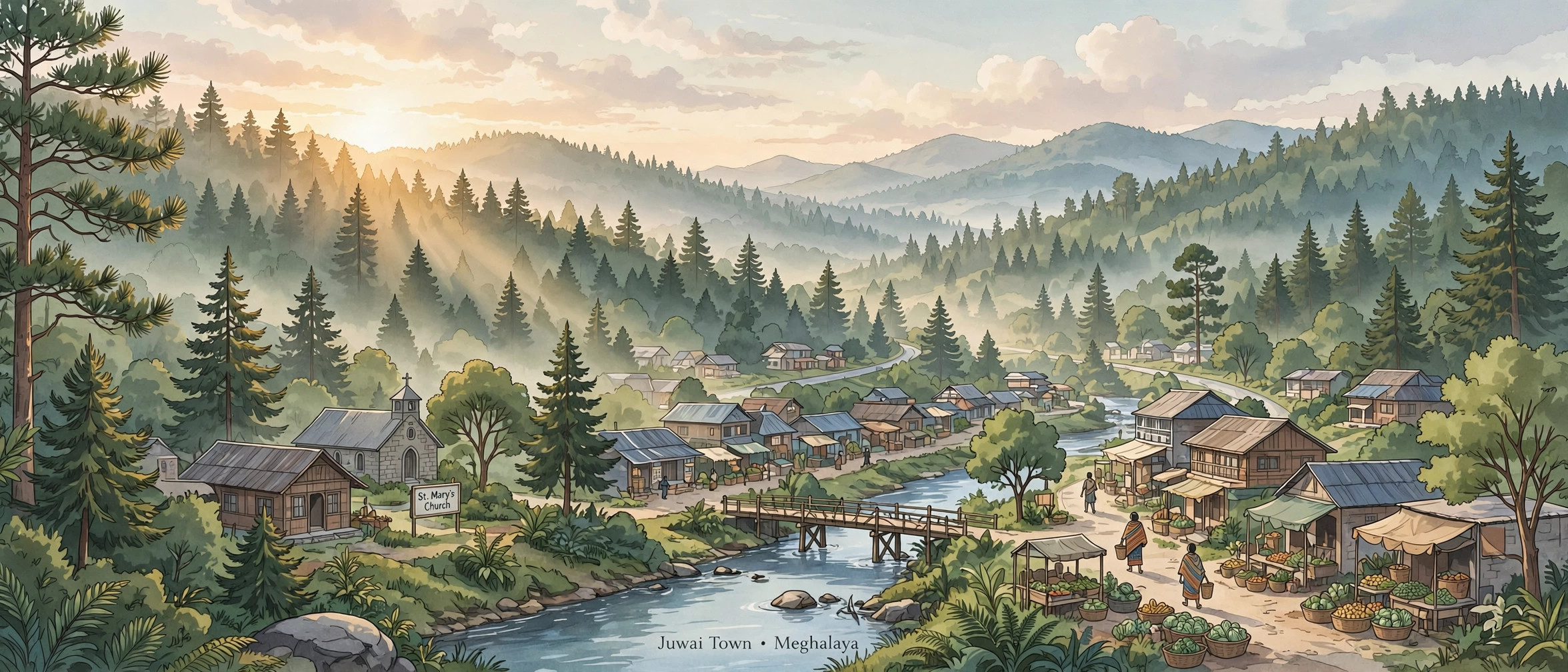
The town’s geography also plays a role. Juwai sits at a comfortable hill elevation, and its mornings are cool and clear for much of the year. The archery ground used for the morning session operates in daylight hours, and the morning timing takes advantage of the best weather of the day before the afternoon showers that the hills are famous for can roll in. Players who have visited the region often note how the morning session feels different from the big afternoon sessions in Shillong. The crowds are smaller, the pace is less frantic, and the whole affair carries the unhurried confidence of a town that has been doing this for a long time.
The Jaintia Hills teer culture
Within Meghalaya, teer is not a single monolithic game but a family of local sessions, each with its own ground, its own counters and its own following. Shillong has the largest and most famous sessions, Khanapara serves the Guwahati border region, and Juwai serves the Jaintia Hills. The Jaintia Hills teer culture has its own character. Players here are often long-term participants who buy small, regular tickets rather than large speculative ones. The morning session suits this style. It allows a player to participate early, know the outcome by midday, and decide calmly whether to continue with the day or night sessions. There is a patience to the Jaintia Hills approach that the morning session rewards.
The archery behind the numbers
Every teer session, morning included, is rooted in archery. Groups of archers shoot arrows at a target, traditionally a cylindrical bundle of straw, and the number of arrows that hit the target determines the result. Only the last two digits of the total count become the declared number, which is why teer results are always two-digit numbers from 00 to 99. The morning session in Juwai follows this same format. Archers gather at the ground, officials and representatives of the local association oversee the shooting, the arrows are counted, and the last two digits are announced as the round’s result. If you want to follow the wider Juwai market beyond the morning session, the dedicated Juwai teer result page on All Teer covers the full day’s Juwai sessions.
How the Juwai Morning Teer Session Works, FR and SR Explained
Like every standard teer session, the Juwai morning session is played in two rounds, the first round and the second round, universally shortened to FR and SR. The two rounds are separate draws with separate archery shootings, separate ticket sales and separate declared numbers. Buying a ticket for the first round does not enter you in the second round, and the FR result has no mechanical effect on the SR result. Each round is an independent event. This is the single most important thing for a new player to understand, because confusion between rounds is the most common beginner mistake.
The first round
The first round is the opening draw of the morning session. Ticket sales for FR open early in the day and close a fixed interval before the archers begin shooting, so that counters can finalise their books. The archers then shoot the first round, the arrows are counted under supervision, and the last two digits of the hit count are declared as the FR number. In the daily flow, the FR declaration is the moment the juwai morning teer result conversation begins, because the first number of the day is now public. Players check it, counters settle FR payouts, and attention immediately turns to the second round.
The second round
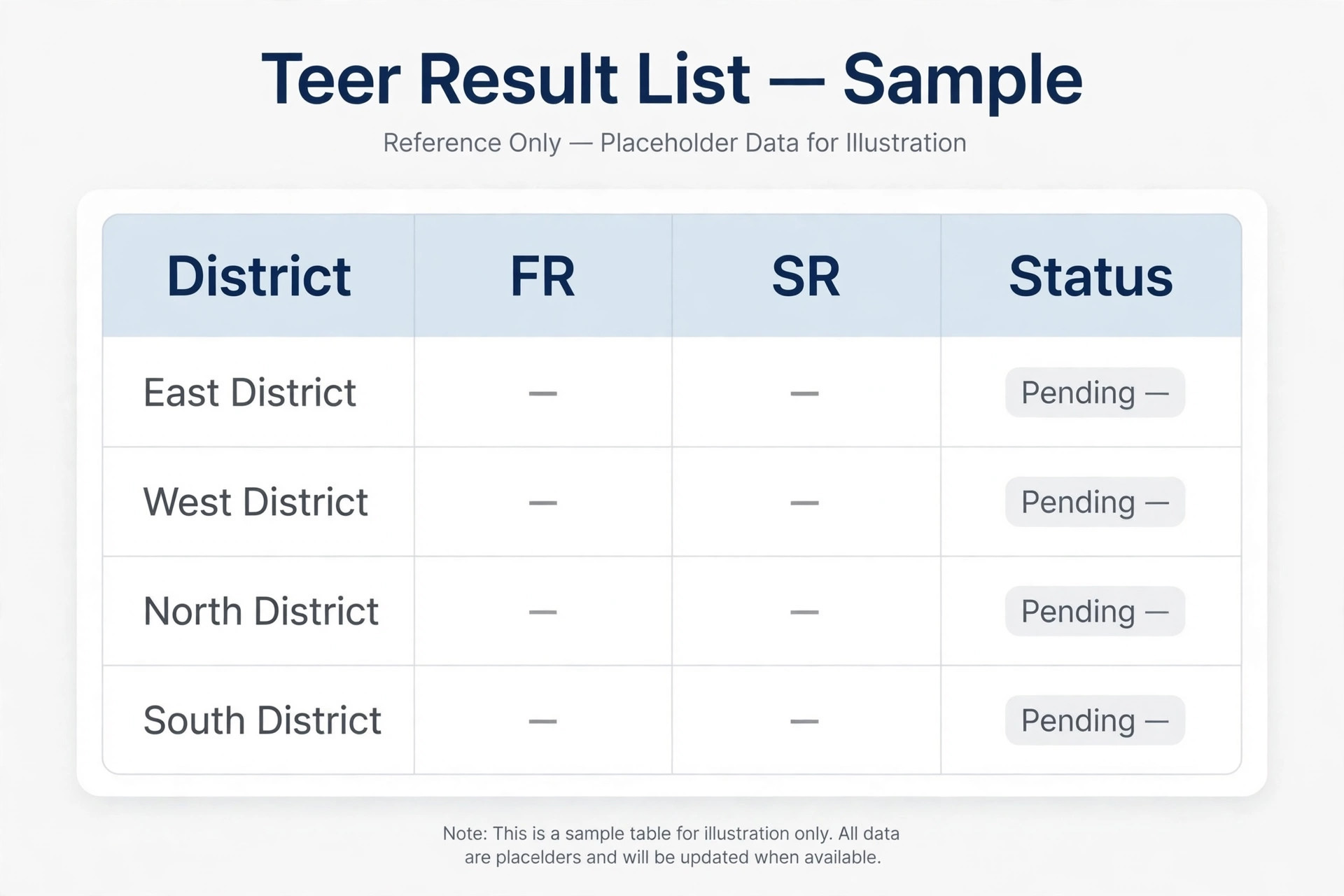
The second round follows the first after a scheduled gap. Fresh tickets are sold for SR, the archers shoot again, and a second two-digit number is declared. The SR number completes the morning session. Together, the FR and SR numbers make up the full morning session result for that date. A typical morning teer list therefore shows three things for each date, the date itself, the FR number and the SR number. When a result is not yet declared, a well-maintained list shows a dash placeholder rather than a guess, and it should be read exactly that way, as pending, not as zero.

A worked example of the number format, example only
To make the format concrete, here is how a morning session entry looks on a result list. This is an illustration of the format only, not a real result.
- Date – 2026-09-30
- FR – – (example only, not a real result)
- SR – – (example only, not a real result)
The dashes mean no number has been published or the entry is being shown purely to demonstrate layout. Real results are always two digits, 00 through 99. Any page that shows you a morning number without a declared source, or that mixes morning numbers with day or night session numbers, is not a page you should trust. The morning session stands alone, with its own FR and SR.
Ticket sales and the sales cutoff
Each round has a sales cutoff, a time after which no more tickets for that round can be bought. The cutoff exists so that the total ticket sales can be reconciled before the archers shoot. For the morning session, the FR cutoff falls in the morning and the SR cutoff follows later, ahead of the second round. Players who arrive at a counter after the cutoff cannot buy tickets for that round and must wait for the next one. This is why the schedule flow matters so much in practice. Knowing the session order, morning then day then night, and the round order within each session, FR then SR, tells you exactly which tickets are still available at any hour of the day.
Juwai Morning Teer Result Today, the Daily Schedule Flow
The phrase players search most often is the juwai morning teer result for today, and the reason is practical, not sentimental. Teer is a daily game, and yesterday’s numbers have no bearing on today’s draws. Each day is a fresh calendar. The morning session opens the day, the day session continues it, and the night session closes it. If you follow teer daily, your routine naturally starts with the morning result, because it is the first confirmation that today’s calendar is live and running.
The three sessions in order
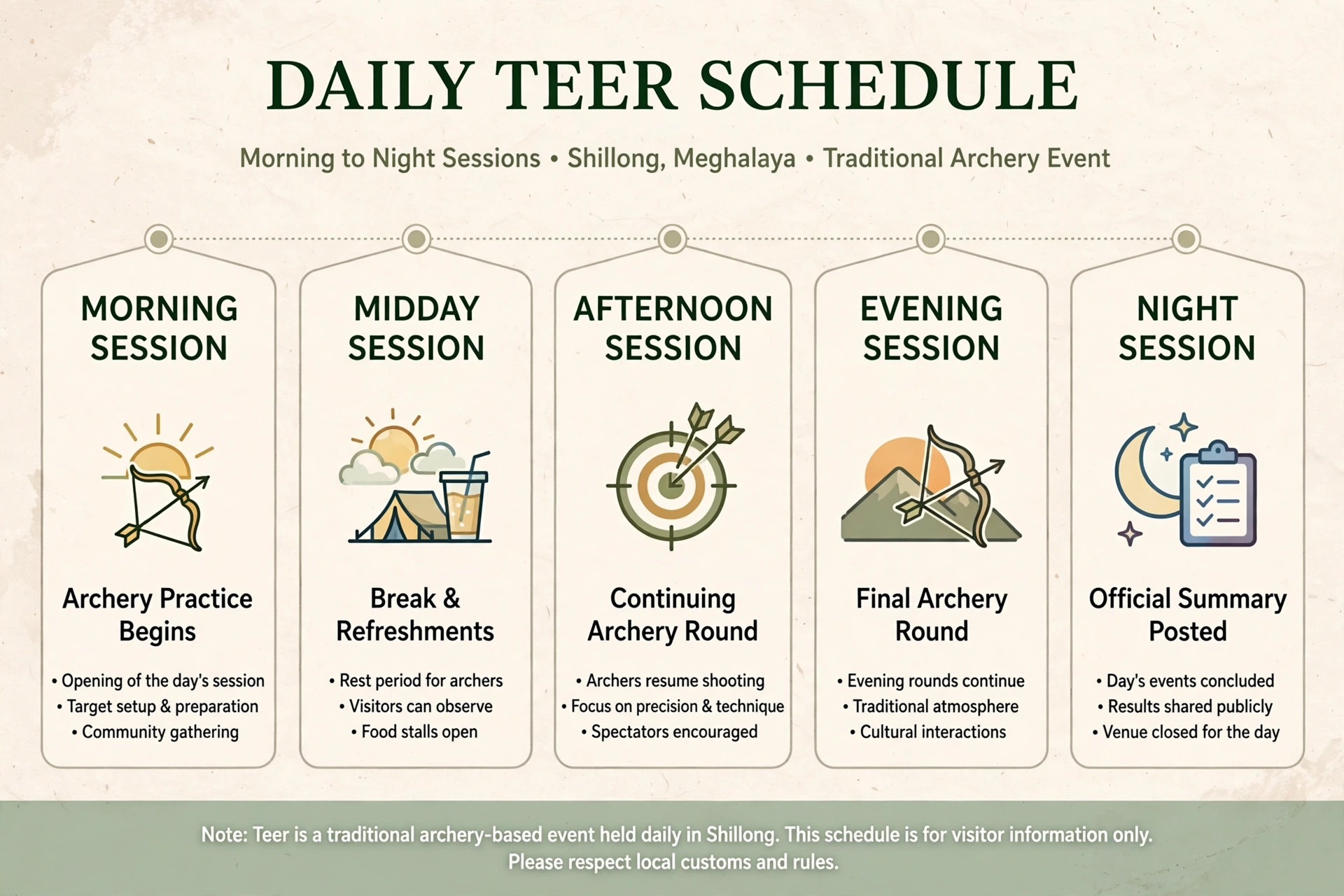
The standard daily flow for the Juwai region runs in this order. Step 1 – Morning session, FR then SR, declared in the late morning to early afternoon window. Step 2 – Day session, FR then SR, declared through the afternoon. Step 3 – Night session, FR then SR, declared in the evening. Each session is independent. The morning session’s numbers do not determine the day session’s numbers, and none of them determine the night session. Treating them as linked, for example by assuming a morning number predicts an afternoon one, is a misunderstanding of how the draws work. The archers shoot fresh arrows every round, and every round is its own event.
Timing and the declaration window
Exact declaration times can shift slightly with the season, the day of the week and local arrangements, so a responsible guide states the pattern rather than promising a minute. The morning session’s first round is generally declared around the late morning, and the second round follows roughly an hour later, with the full morning session complete by the early afternoon. The day session then takes over the afternoon, and the night session closes the evening. Sundays are the traditional weekly holiday for teer in Meghalaya, when no sessions are held, so a Sunday will show no morning, day or night results. Festival days and special circumstances can also pause the calendar. When a session does not run, a correct result list shows the day as closed or holiday, never a fabricated number.
Building a daily checking routine
Regular followers develop a simple routine. In the morning, they confirm whether today is a playing day or a holiday. Around the late morning window, they check the FR number of the morning session. About an hour later, they check the SR number, which completes the morning session. In the afternoon they move on to the day session, and in the evening to the night session. This routine works because the calendar is ordered and predictable. The morning result is step one of three, and missing it means starting the day’s follow-up mid-stream. New followers sometimes begin with the night session because it is the most talked about, then work backwards. Starting with the morning session is simpler and gives the full picture of the day.
Reading the Juwai Morning Teer List Correctly
A morning teer list is a date-wise record of the session’s FR and SR numbers. On All Teer, the teer result list page keeps these records organised by date and session so you can look back at previous days as well as check the current one. Reading the list correctly is a small skill, but it prevents the two most common errors, mixing sessions and trusting undeclared numbers.
The anatomy of a list entry
Each entry on a proper morning teer list contains the date, the session label, the FR number and the SR number. The session label is what keeps the morning session separate from the day and night sessions on the same date. If a list shows only numbers without session labels, treat it with caution, because you cannot tell whether a number belongs to the morning, day or night draw. The best-maintained lists also mark the status of each round, declared or pending, so you can see at a glance whether the SR is still awaited or the session is complete.
Previous results and what they are for
Result lists keep history, usually the last several days or weeks of morning session numbers. This history has legitimate uses. It lets you verify a number you heard by word of mouth, it lets a counter reconcile payouts, and it gives researchers a record of how the sessions ran on past dates. What history does not do is predict the next number. Every round is an independent archery draw, and past numbers carry no information about future ones. Pages that present historical lists alongside claims about patterns, hot numbers or due numbers are mixing a legitimate record with illegitimate advice. Read the history as history, and nothing more.
Spotting an unreliable result source
Because the morning session is the first result of the day, it is also the first target for unreliable pages. A few checks keep you safe. First, the source should label the session clearly as the Juwai morning session, with FR and SR shown separately. Second, it should never show a number before the declaration window for that round has passed. Third, it should mark holidays and non-playing days honestly instead of filling them with numbers. Fourth, it should not mix morning numbers with numbers from other sessions or other towns. A page that fails any of these checks is not worth your attention, no matter how early it claims to publish.
The Morning Session Compared, Morning, Day and Night
It helps to see the three sessions side by side, because each has a distinct character and audience even though the mechanics are identical.
Morning session
The morning session belongs to Juwai’s early hours. Its players are the town’s working population, its counters open with the market, and its results are out by the early afternoon. It is the quietest of the three sessions in terms of crowd and hype, and the most routine, which regular players consider a virtue. For the Jaintia Hills, it is the home session.
Day session
The day session is the afternoon continuation, serving players whose day frees up after lunch. It draws a wider audience than the morning session because the afternoon timing suits more schedules, and in the overall teer conversation it tends to get more attention. Structurally it is identical to the morning session, FR then SR, independent draws, same two-digit format.
Night session
The night session is the evening close of the daily calendar. It catches everyone who missed the earlier sessions and carries the most anticipation simply because it is the last result of the day. Like the others, it is FR then SR, and like the others, it is independent of what came before. A full day of teer, morning to night, is six independent draws, two per session, each one a fresh shooting of arrows.
Understanding this three-session structure also explains why the morning session matters out of proportion to its noise level. It sets the day’s calendar in motion. Counters, players and followers all orient themselves by it, and the day and night sessions inherit the rhythm it establishes.
A Note on Responsible Play
Teer is a legal lottery in the state of Meghalaya, conducted under state regulation, and participation is for adults aged eighteen and above only. If you choose to participate, treat it as entertainment with a fixed budget, never as a way to earn a living or recover losses. Set a spending limit before the day begins, stick to it regardless of the morning session’s outcome, and walk away when the limit is reached. No number, no session and no day is ever due to produce a particular result, and no strategy changes the fact that each round is an independent draw. If playing stops being enjoyable or starts affecting your finances, relationships or work, stop and seek support. The morning session will be there tomorrow, and so will the choice to sit a day out. You can read more about the team behind this guide on the About Us page.
Frequently Asked Questions
What is the juwai morning teer result?
The juwai morning teer result is the declared outcome of the morning teer session held in the Juwai region of the Jaintia Hills, Meghalaya. It consists of two numbers, the first round (FR) number and the second round (SR) number, each a two-digit number from 00 to 99 derived from the archery shooting of that round. It is the first teer result declared each playing day, ahead of the day and night sessions.
What time is the Juwai morning teer result declared?
The morning session’s first round is generally declared in the late morning and the second round follows about an hour later, so the full morning session is usually complete by the early afternoon. Exact times can vary by season and local arrangement, so treat the pattern as a guide rather than a fixed minute. Result lists mark each round as declared or pending, which is the reliable way to know whether a number is out.
What is the difference between FR and SR in the morning session?
FR and SR are the first round and second round of the morning session. They are two separate archery draws with separate ticket sales and separate declared numbers. A ticket bought for the first round applies only to the first round. The FR number has no effect on the SR number, and neither round influences any other session of the day.
Does the Juwai morning session run on Sundays?
No. Sunday is the traditional weekly holiday for teer in Meghalaya, and no sessions are held, morning, day or night. A correct result list will show Sunday as a holiday or closed day rather than showing numbers. Festival days and special circumstances can also pause the calendar on other days.
Where does the morning session fit among the day’s teer sessions?
The day’s teer calendar runs in a fixed order, morning session first, day session second, night session third. Each session has its own FR and SR rounds. The morning session is the earliest, which is why regular followers check it first, and each session is independent of the others.
Can yesterday’s morning result tell me today’s number?
No. Every round is an independent archery draw, and past numbers carry no information about future ones. Historical lists are useful for verifying numbers you heard, reconciling with counters and keeping records, but they cannot predict the next draw. Any claim that a past morning result points to a future number should be ignored.
Conclusion
The juwai morning teer result opens the daily teer calendar in the Jaintia Hills, two rounds of archery, FR then SR, played in the morning hours of a hill town that has always done its business early. It fits Juwai’s rhythm, serves its working population, and gives every follower the first confirmed numbers of the day before the day and night sessions take over. Follow the schedule in order, read the list by session and round, treat each draw as independent, and keep play responsible and within a fixed budget. That is the whole of the morning session, simple, traditional, and first by design.