
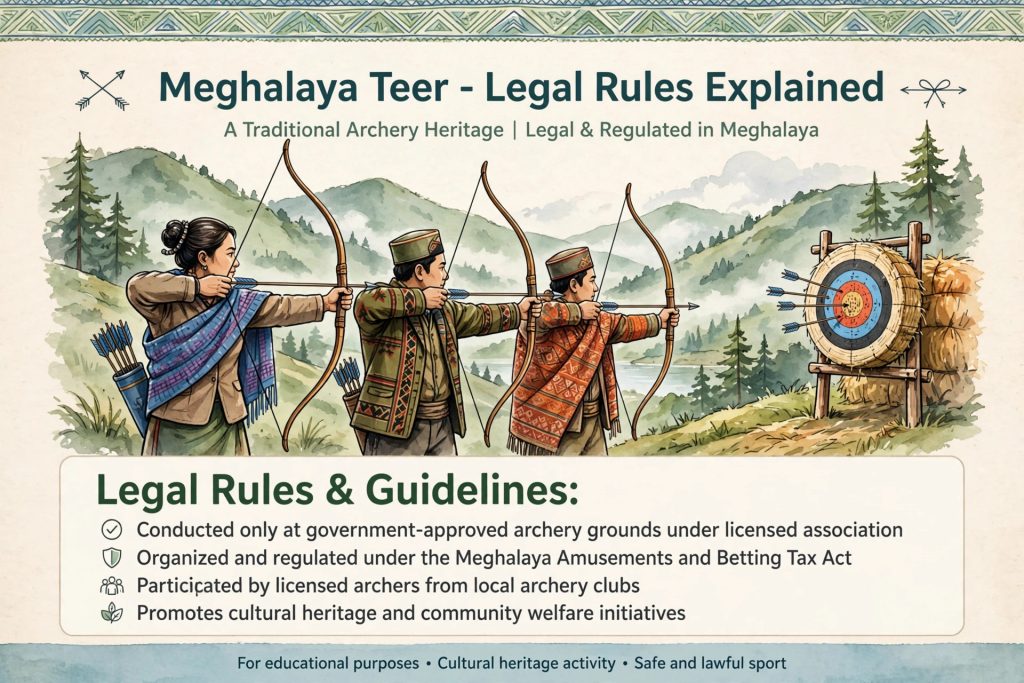
Meghalaya teer is one of the most unusual lotteries in India. It is not a draw from a drum or a computer-generated outcome. It is a real archery contest, watched by the public, in which the number of arrows striking a target decides the winning number. Because the game runs openly every working day and attracts thousands of participants, it is regulated by state law rather than left to informal custom. This guide explains the rules of the game inside its legal frame: how a teer day runs from ticket sale to result, what the ticket rules are, who conducts and supervises the shooting, how results are declared, who may play, and what happens when a round is cancelled. If you want a quick reference for checking declared outcomes, the All Teer homepage publishes the latest numbers each day.

What Meghalaya Teer Is
Teer is an archery-based betting game conducted in Meghalaya. In each round, a group of archers shoots a fixed number of arrows at a target. Officials then count how many arrows struck the target. The last two digits of that count become the winning number. A bettor who chose that number on a ticket wins the round. Because the outcome depends on a physical event that spectators can watch, teer is often described as a sport-lottery: part sporting contest, part lottery-style wager.
The game is rooted in the archery traditions of the Khasi hills, where archery has long been both a skill and a community pastime. Formal organised teer, with printed tickets, licensed counters and fixed schedules, grew out of that tradition and was eventually brought under written regulation. Today meghalaya teer operates within a legal structure that names who may sell tickets, who may conduct the shooting, and how the results must be handled. Understanding those rules is the difference between participating in a licensed game and stumbling into an unlicensed one.
Teer as a regulated sport-lottery
The phrase “sport-lottery” captures the dual nature of the game. On the sport side, there is genuine archery: archers, bows, arrows, a target, and an official count. On the lottery side, there is a ticket, a stake, a chosen number and a payout. The state treats the combination as a licensed amusement and betting activity, which is why the licensing statute is a tax-on-betting law rather than a pure gambling ban. The rules below reflect that structure: they govern the sporting event and the betting on it together.
The Legal Frame Around Meghalaya Teer
A common question is whether teer is legal. The short answer is that teer lottery meghalaya is legal when it is conducted under the state licensing regime. Several state-level legal instruments create that regime, and it is worth knowing their names and roles so that players, writers and curious readers do not repeat vague or incorrect claims about the law.
Section 14A of the 1982 Amendment Act
Betting on teer in Meghalaya is licensed under Section 14A of the Meghalaya Amusements and Betting Tax (Amendment) Act, 1982. That provision creates licensed bookmakers for arrow shooting and expressly states that “arrow shooting” includes the game of teer. In practical terms, this is the provision that allows a person or body to take bets on teer results lawfully, subject to the licence conditions the state imposes. The full text of the amendment sits on the official state portal, and readers who want to read the provision itself can find it there (see the reference link at the end of this article).
The 2018 Regulation Act
The Meghalaya Regulation of the Game of Arrow Shooting and the Sale of Teer Tickets Act, 2018 further regulates the game and the sale of teer tickets. Where the 1982 amendment created the licensing power, the 2018 Act spells out the machinery: how the game is to be conducted and how tickets are to be sold. Anyone describing the rules of meghalaya teer should understand that these two instruments work as a pair, the older act granting the licence-based permission and the newer act organising the detail.
The 1970 Prevention of Gambling Act
The Meghalaya Prevention of Gambling Act, 1970 is the statute that generally empowers the government in relation to gambling, and it allows the government to exempt notified games from its prohibitions. Teer operates within the space created by that exemption structure: the game is not an unregulated wager but a notified, licensed activity. This is the point that answers “is teer legal” in a precise way. It is legal as a licensed game under these state acts, and it would not be legal outside them.
Discussion in the Law Commission of India
The Law Commission of India discussed this framework in its Report No. 276 on the legal framework for gambling and sports betting in India, in the section dealing with Meghalaya. The report notes how the state has dealt with teer through its own legislation. For readers who want an authoritative national-level overview of how Meghalaya’s arrangement fits into Indian law as a whole, the Law Commission report is the standard reference, and it is linked at the end of this article.
How a Teer Day Works
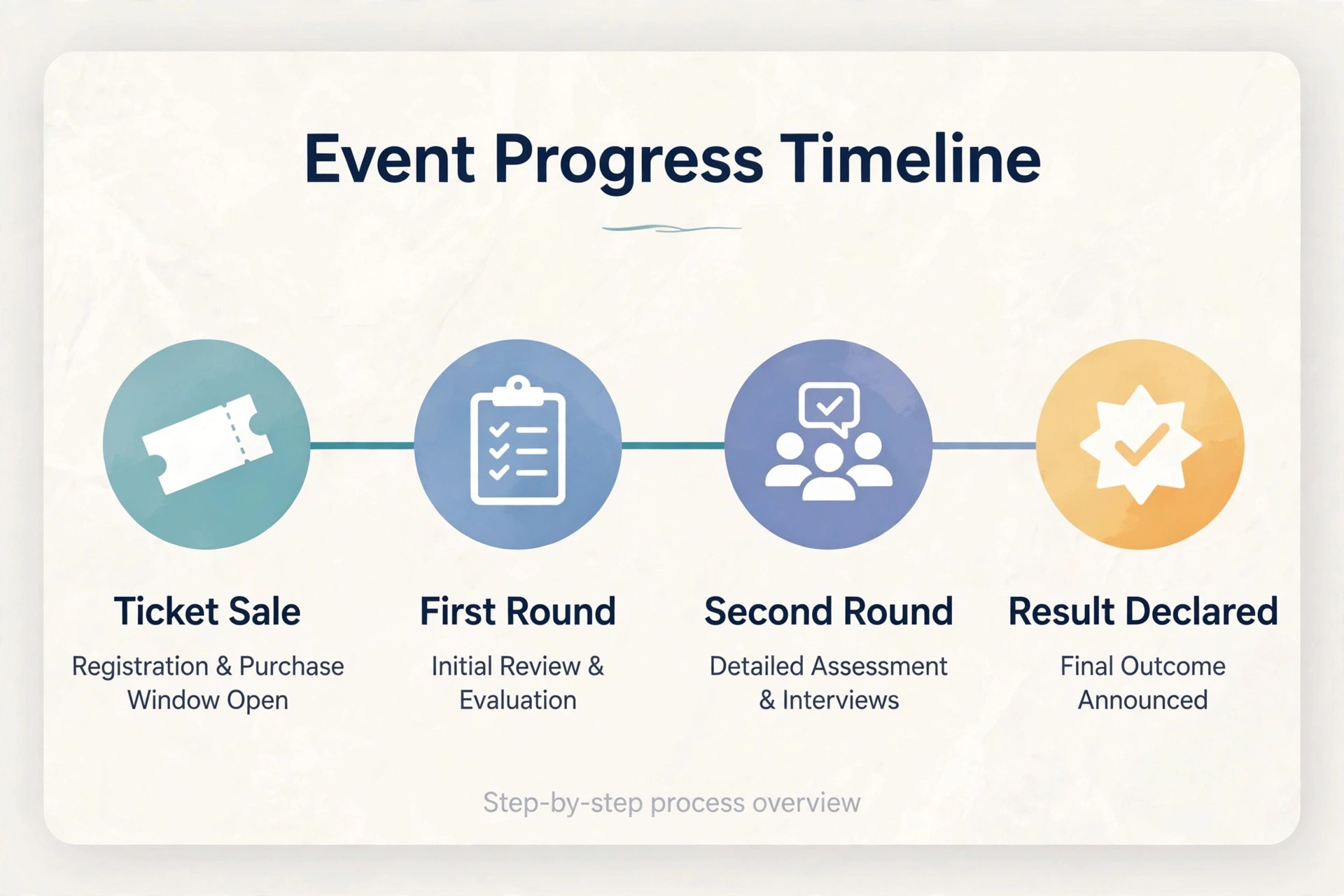
A teer day follows the same sequence every working day. Knowing the order of events matters, because each step has its own rules, and a player who understands the sequence knows when tickets close, when each round happens, and when the numbers are declared.
Step 1 – Ticket sale at licensed counters
The day begins with ticket sales. Teer tickets are sold at licensed counters in the areas where the game is conducted. Betting opens before the shooting and closes before the first round begins. The ticket is a printed slip on which the bettor’s chosen number appears. Ticket rules set by regulation are strict on one point above all: buy only at licensed counters, and keep the ticket safe, because the physical slip is the proof of the wager. A lost or damaged ticket can make claiming a win difficult or impossible.
Step 2 – The first round (FR)
After ticket sales close, the shooting session begins. The first round is called FR. Archers shoot their arrows at the target under the supervision of the conducting officials. When the shooting for the round is complete, the arrows that struck the target are counted. The last two digits of that count are declared as the FR result. The FR round therefore sets the day’s first winning number.
Step 3 – The second round (SR)
After a break, the second round, called SR, is shot in the same way: archers shoot, officials count the arrows that hit the target, and the last two digits of the count become the SR result. The SR round is a separate wagering event with its own winning number; tickets are marked for the round they apply to, and a number that wins in FR does not automatically win in SR.
Step 4 – Result declaration
Once the counting for a round is complete, the result is declared and announced publicly. Results travel from the shooting ground through the licensed counters and through result publications. On this site, the daily numbers appear on the All Teer homepage and in the teer result list archive, which keeps past days’ numbers for reference.
How the Winning Number Is Formed
The number format is simple but often misunderstood, so it deserves its own explanation. Bettors choose a number from 0 to 99. That number represents the last two digits of the total count of arrows hitting the target in the round.
If, for example, the officials count a total number of arrows that ends in two particular digits, those two digits are the winning number (example only, not a real result: the display placeholder “-” marks where a declared number would appear, never a prediction). A player whose ticket carries those same two digits wins the round. There are one hundred possible outcomes, from 00 to 99, which is why the game is sometimes described as a two-digit lottery.
FR and SR are independent rounds
Each session has two rounds per session, called the first round (FR) and the second round (SR), and each round produces its own result. The count from FR has no influence on the count from SR, and the two numbers are declared separately. Players may hold tickets for one round or for both, but each ticket is tied to its round.
Ticket Rules Set by Regulation
Because teer is a licensed activity, the tickets themselves are regulated. The rules below are the ones a player will actually encounter at a counter.
Buy only at licensed counters
Tickets for meghalaya teer may be sold only at licensed counters. This is the single most important ticket rule. A counter operating without a licence is not part of the legal game, and a ticket from such a counter is not a ticket in the licensed game at all. Players should buy only where a licence is displayed and should be wary of anyone selling teer tickets informally, over the phone from an unknown source, or through unofficial channels.
Keep the ticket safe
The printed ticket is the player’s proof of the wager. Regulation-era practice is clear: the ticket must be kept safe and intact until results are declared and any claim is settled. A faded, torn or lost slip creates problems at claim time, because the counter needs to verify the ticket before paying. Treat the slip the way you would treat any valuable receipt.
Tickets are round-specific
A ticket names the round it belongs to. A ticket bought for FR is valid only for the FR result; a ticket bought for SR is valid only for the SR result. Buying for the wrong round, or assuming a number carries over, is a common beginner mistake. Check the round printed on the slip before leaving the counter.
Stake and payout are fixed by the counter
The amount staked on a number and the teer prize for a win are set by the licensed counter, and the payout is a fixed multiple of the stake. Keep teer prize descriptions general when comparing counters: the multiplier is a matter of the counter’s published terms, and players should confirm the payout terms at the point of purchase rather than relying on word of mouth. This article does not state a specific multiplier as fact, because the terms are set by the licensed counters and can differ.

Who Conducts the Shooting and Who Supervises
A licensed game needs identifiable people in charge, and teer has them. Teer is conducted under the aegis of the Khasi Hills Archery Sports Association. The association’s involvement is what ties the modern licensed game back to the archery tradition it grew from, and it is the body named in connection with the conduct of the shooting.
The shooting itself is carried out by archers, and the counting of arrows is done under official supervision so that the declared number reflects the actual count. The presence of spectators at the shooting ground is part of the game’s character: the count is not a back-room figure but something that happens in the open, in front of the public. Licensed counters handle the commercial side, selling tickets and settling wins, while the sporting side, the archers, the targets and the count, is what produces the result.
Why supervision matters
Supervision is what separates a licensed teer round from an informal wager on archery. The licensed framework exists precisely so that the ticket sale, the shooting, the counting and the declaration all happen under named authority. A game conducted without that authority is outside the legal frame described in this article, even if it copies the format.
Result Declaration Process
The result declaration process is the bridge between the shooting ground and the player holding a ticket. After the arrows of a round are counted, the two-digit number is declared. The declaration is made publicly at the ground and then communicated outward: licensed counters display or announce it, and result publications carry it the same day.
On All Teer, declared numbers are published daily on the homepage and preserved in the teer result list, so readers can check a day’s FR and SR numbers and look back at earlier days. Because results are a matter of public record once declared, archiving them is straightforward; the discipline is to publish only numbers that have actually been declared and never to present a placeholder, guess or projection as a result.
Player Rules – Who May Play
The player-side rules are simple and non-negotiable.
18+ age requirement
Teer is a legal lottery in Meghalaya for adults aged 18 and above only. Minors may not buy tickets or place wagers, and licensed counters are expected to enforce the age rule. Any adult considering the game should be aware that the age bar is a legal requirement, not a suggestion.
Responsible play
Teer is a form of betting, and every betting game carries the risk of loss. Play only with money you can afford to lose, set a limit before you buy a ticket, and treat the game as entertainment rather than a source of income. If playing stops being enjoyable, stop playing. This site publishes results and information; it does not encourage anyone to bet beyond their means.
Play within the licensed game
The rules in this article describe the licensed game: licensed counters, regulated tickets, supervised shooting, declared results. Playing outside that structure, through unlicensed sellers or informal arrangements, means stepping outside the legal protections the framework provides. The responsible choice is also the legal one: use the licensed counters.
What Happens on Holidays or Cancelled Rounds
Not every calendar day is a teer day. Rounds can be cancelled for public holidays, for local festivals or observances, for adverse weather that makes shooting impractical, or for administrative reasons. When a round is cancelled, no result is declared for that round, and there is no number to publish.
Players should check before travelling to a counter on a day that might be a holiday, and readers checking results should not mistake a blank day in the archive for missing data. The teer result list shows only days on which results were actually declared. If a round is cancelled after tickets were sold, the handling of stakes is a matter for the licensed counter’s published terms and the applicable regulations; players should ask the counter directly about refunds or carry-over policies rather than assuming an outcome.
Meghalaya Lottery in Context
The meghalaya lottery landscape includes more than teer. The state has long been associated with regulated betting on arrow shooting, and the statutes discussed above are specific to that game. Other forms of lottery and betting in the state fall under their own legal provisions, and nothing in this article should be read as a statement about games other than teer. The point of the legal section above is narrow and precise: teer betting in Meghalaya is licensed under Section 14A of the Meghalaya Amusements and Betting Tax (Amendment) Act, 1982, further regulated by the 2018 Act, within the exemption structure of the 1970 Act, conducted under the aegis of the Khasi Hills Archery Sports Association, and discussed in the Law Commission of India’s Report No. 276.
Frequently Asked Questions
Is teer legal in Meghalaya?
Yes, when conducted under the state’s licensing regime. Teer betting is licensed under Section 14A of the Meghalaya Amusements and Betting Tax (Amendment) Act, 1982, further regulated by the Meghalaya Regulation of the Game of Arrow Shooting and the Sale of Teer Tickets Act, 2018, and situated within the exemption structure of the Meghalaya Prevention of Gambling Act, 1970. An unlicensed game copying the teer format is not covered by that legality.
What are the two rounds in meghalaya teer?
Each session has two rounds: the first round (FR) and the second round (SR). In each round, archers shoot at a target, officials count the arrows that hit, and the last two digits of the count become that round’s winning number. The two rounds are independent, each with its own result.
How is the winning number decided?
The winning number is the last two digits of the total number of arrows striking the target in the round. Bettors choose a number from 0 to 99, and a ticket wins if its number matches those last two digits. The count is done under supervision at the shooting ground and then declared publicly.
Where can I buy a teer ticket?
Only at licensed counters. The ticket rules set by regulation require purchase at a licensed counter, and the printed slip must be kept safe as proof of the wager. Avoid informal or unlicensed sellers.
Who supervises the game?
Teer is conducted under the aegis of the Khasi Hills Archery Sports Association, with the shooting, counting and declaration carried out under official supervision. Licensed counters handle ticket sales and payouts.
What happens if a round is cancelled?
No result is declared for a cancelled round. Cancellations can happen on public holidays, during local observances, in bad weather, or for administrative reasons. Check with the licensed counter about how stakes are handled for a cancelled round.
Where can I check declared results?
Declared FR and SR numbers are published on the All Teer homepage and archived in the teer result list. Only declared numbers are published; placeholders are never presented as results.
Conclusion
Meghalaya teer is best understood as a game with two halves that the law holds together: a genuine archery contest and a licensed lottery built on its outcome. The rules cover the full journey from the licensed counter to the declared number, the ticket that proves the wager, the two rounds called FR and SR, the supervision of the shooting, and the age and responsibility requirements for players. Played inside that legal frame, teer is a regulated part of Meghalaya’s sporting life. Readers who want the day’s declared numbers can find them on the All Teer homepage, and questions about the site can go through the contact page.
References and further reading
- The Meghalaya Amusements and Betting Tax (Amendment) Act, 1982 on the official Meghalaya state portal: the text of the Amendment Act on meghalaya.gov.in
- The Law Commission of India Report No. 276, Meghalaya section: Law Commission report on gambling and sports betting in India
- Learn more about this site on the about page or get in touch via the contact page.